

The ECB-BIG index: tracking credit conditions in the euro area
Prepared by Anastasia Allayioti, Paola Di Casola and Giacomo Magistretti
Published as part of the ECB Economic Bulletin, Issue 5/2026.
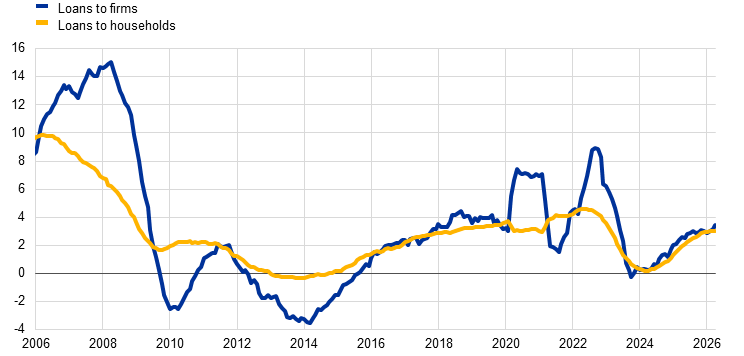
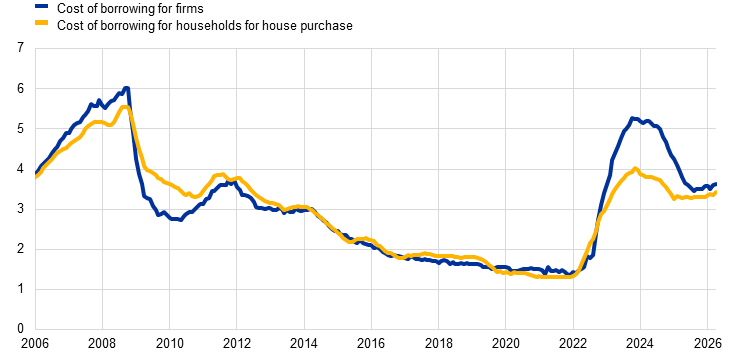
The European Central Bank Broad Intermediation Gauge (ECB-BIG) index is a new indicator that provides a timely assessment of developments in intermediation conditions across banks and non-banks. The ECB-BIG index tracks euro area credit conditions using a broad set of indicators that shed light on credit availability, needs and costs across the economy. It provides a useful summary of credit conditions, particularly when individual indicators appear to give contrasting signals. For example, at the beginning of the global financial crisis, growth in bank loans to households had already begun to slow, while that in bank loans to firms continued to grow at a steady rate in the first few months of 2008 before decelerating sharply (Chart A, panel a). In recent months bank loans have continued to grow at a stable rate, while lending rates have started to increase, suggesting that credit conditions might be tightening (Chart A, panel b). The ECB-BIG index provides the first comprehensive summary of these and other indicators of credit conditions in the euro area.
Chart A
Indicators of euro area credit conditions
a) Annual growth in bank loans
(annual percentages)
b) Cost of borrowing
(annual percentages)
Sources: ECB and ECB staff calculations.
Notes: In panel a), bank loans are adjusted for sales, securitisation and cash pooling. The latest observations are for April 2026.
The new indicator combines the advantages of reduced-form and structural methodologies. It is constructed using conditional forecasting techniques applied within a Bayesian vector autoregressive (BVAR) model that can handle large mixed-frequency datasets of financial, credit and macroeconomic variables. The approach builds on Crump et al. (2025) who developed an index of US financial conditions based on a structural conditional forecasting exercise within a quarterly macro-financial BVAR model. Unlike approaches such as principal component analyses or dynamic factor models, this methodology allows for different transmission channels rather than imposing an identical lead-lag relationship on the variables. We have extended this framework to account for: (i) variables released at different frequencies, following recent advances in the literature on BVAR models (Cimadomo et al., 2022); and (ii) broader financing conditions. The ECB-BIG index measures the impact of financial and credit shocks on investment – an indicator of economic activity closely linked to credit conditions. More precisely, the index can be defined as the in-sample forecast of investment conditional on credit and financial shocks. It is normalised, with positive (negative) values indicating relatively tight (loose) credit conditions.
The index captures the interlinkages between financial and credit variables on the one hand, and macroeconomic variables on the other hand. This is particularly important because macroeconomic variables respond to financing conditions – typically with a delay – while financial and credit variables react to macroeconomic news.[1] The macroeconomic variables included in our macro-financial-credit BVAR model are GDP, investment, the Composite Purchasing Managers’ Index, the price level, unemployment and an index of economic policy uncertainty.[2] We compile a diverse set of monthly and quarterly variables covering key aspects of credit conditions in the euro area: (i) bank lending rates and bank loans to households and firms, (ii) loans to firms from non-banks and the rest of the world, (iii) debt securities and equity issued by firms, (iv) credit standards for households and firms from the euro area bank lending survey, and (v) financial market conditions proxied by the Macro-Finance Financial Conditions Index (MF-FCI) developed in Bletzinger et al. (2026).
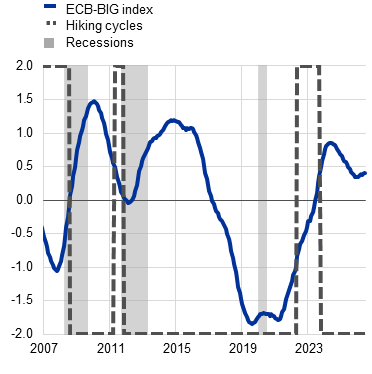
The ECB-BIG index currently points to intermediation conditions being tighter than those observed before the start of the war in the Middle East. The index has peaked during three main periods (Chart B, panel a). First, the global financial crisis of 2007-09, a period characterised by a sharp contraction in credit supply, as evidenced by the euro area bank lending survey. During this time financial institutions faced liquidity shortages, heightened risk aversion and widespread deleveraging. Second, the aftermath of the European sovereign debt crisis around 2014, a period marked by heightened financial fragmentation across euro area countries and the emergence of deflationary risks. Many banks, particularly those in more indebted countries, reduced lending at that time amid constrained access to market funding and elevated non-performing loan ratios. Third, the 2022-23 hiking cycle, a period during which the ECB rapidly raised interest rates in response to surging inflation following the energy price shock driven by Russia’s invasion of Ukraine. More recently, the index has pointed to some renewed, albeit more limited, tightening of credit conditions following the geopolitical and energy price shocks triggered by the war in the Middle East. The recent tightening reflects pressure stemming from price components, most notably lending rates (Chart B, panel b).
Chart B
The ECB-BIG index, economic recessions and rate hiking cycles
a) The ECB-BIG index |
b) Change in the ECB-BIG index |
|---|---|
(index) |
(index) |
 |
 |
Sources: ECB and ECB staff calculations.
Notes: The more positive (negative) the index, the tighter (looser) the credit conditions. In panel a), the latest values are also based on the June 2026 Eurosystem staff macroeconomic projections for the euro area, where the realised data are still missing. In panel b), “Price components” includes lending rates and the MF-FCI, “Quantity components” includes credit volumes and changes in credit standards according to the euro area bank lending survey and “Changes since the war in the Middle East” refers to the change between the nowcast for June and the nowcast for February. The latest observations are for June 2026.
The ECB-BIG index complements indicators of more narrowly defined financial conditions, with diverging results in some periods (Chart C). For example, the MF-FCI and the Goldman Sachs Financial Conditions Indicator (GS-FCI) show an easing of financial conditions for the period 2013-14, while the ECB-BIG index indicates a tightening of intermediation conditions. This primarily reflects developments in banks’ credit standards and credit volumes at that time. Furthermore, the ECB-BIG index did not spike in 2020 despite the major disruption to economic activity triggered by the COVID-19 pandemic, likely reflecting the unprecedented policy interventions that mitigated the potential deterioration in credit conditions.[3]
Chart C
The ECB-BIG index and indices of financial conditions
(index)

Sources: ECB staff calculations and Bletzinger et al. (2026).
Notes: The more positive (negative) the index, the tighter (looser) the credit conditions. The MF-FCI is shown as the gap from its neutral long-run mean, which is the value to which the index converges once euro area inflation is at its medium-term target and the output gap is closed. The GS-FCI is rescaled to have the same mean and variance as the MF-FCI gap since 2005. Both the MF-FCI and the GS-FCI indices refer to the monthly average of daily values. The latest observations are for June 2026.
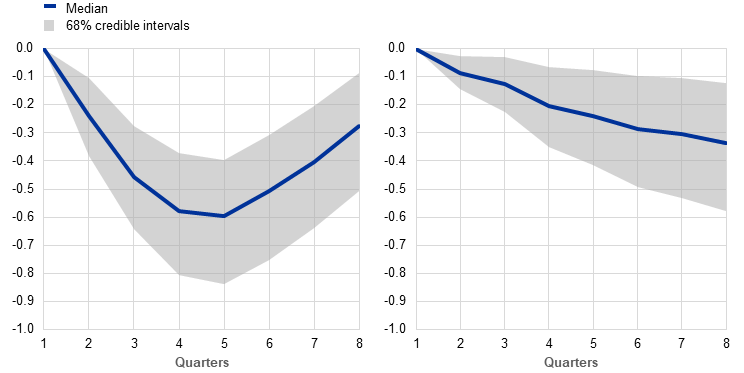
Overall, a tightening shock to the ECB-BIG index has a contractionary impact on the euro area economy. One advantage of an indicator that summarises intermediation conditions is that it allows us to gauge the effects of a shock without having to deal with multiple, often highly correlated variables that provide signals which are difficult to disentangle. Using a quarterly BVAR model, we can show the macroeconomic effects of a tightening shock to the ECB-BIG index: a one standard deviation increase in the index leads to a 0.6% decline in real GDP approximately four quarters after the shock, which reverses gradually thereafter, and reduces the price level (as measured by the Harmonised Index of Consumer Prices – HICP) by around 0.3% after eight quarters (Chart D).
Chart D
Impact of a tightening shock on the ECB-BIG index
a) GDP level |
b) HICP level |
|---|---|
(percentages) |
(percentages) |
 | |
Source: ECB staff calculations.
Notes: The panels show the impulse responses to a one standard deviation (one unit) shock to the ECB-BIG index. The BVAR model includes GDP, investment, the HICP, the one-year overnight index swap rate and the ECB-BIG index, and identifies the shock via Cholesky ordering.
The ECB-BIG index introduced in this box can be a valuable instrument to inform monetary policy decisions. The assessment of the strength of monetary policy transmission is one of the central elements of the ECB’s monetary policy strategy (ECB, 2025). By providing timely assessments of euro area credit conditions, which are crucial for understanding the transmission of monetary policy, the ECB-BIG index can be a useful tool for determining the appropriate monetary policy calibration.
References
Allayioti, A., Bozzelli, G., Di Casola, P., Mendicino, C., Skoblar, A. and Velasco, S. (2025), “More uncertainty, less lending: how US policy affects firm financing in Europe”, The ECB Blog, ECB, 2 October.
Altavilla, C., Barbiero, F., Boucinha, M. and Burlon, L. (2023), “The Great Lockdown: Pandemic response policies and bank lending conditions”, European Economic Review, Vol. 156, July.
Altavilla, C., Giannone, D. and Modugno, M. (2017), “Low frequency effects of macroeconomic news on government bond yields”, Journal of Monetary Economics, Vol. 92, December, pp. 31-46.
Bletzinger, T., Martorana, G. and Mistak, J. (2026), “Looser, tighter, clearer: a new Financial Conditions Index for the euro area”, Working Paper Series, No 3193, ECB, February.
Cimadomo, J., Giannone, D., Lenza, M., Monti, F. and Sokol, A. (2022), “Nowcasting with large Bayesian vector autoregressions”, Journal of Econometrics, Vol. 231, No 2, December, pp. 500-519.
Crump, R.K, Eusepi, S., Giannone, D., Qian, E. and Sbordone, A. (2025), “A Large Bayesian VAR of the U.S. Economy”, International Journal of Central Banking, Vol. 21, No 2, April, pp. 351-409.
European Central Bank (ECB) (2025), “The ECB’s monetary policy strategy statement (2025)”, 30 June.
Legal Disclaimer:
EIN Presswire provides this news content "as is" without warranty of any kind. We do not accept any responsibility or liability for the accuracy, content, images, videos, licenses, completeness, legality, or reliability of the information contained in this article. If you have any complaints or copyright issues related to this article, kindly contact the author above.
